September 2026: rates up, conditions cooling, prices flat
By Brandon · October 16, 2026
The short version: prices are holding, but the market cooled a little in September as mortgage rates climbed to their highest level in a year. After inflation, the typical Charleston-area home is worth less than it was a year ago.
Market conditions: about normal, and cooling
New on the site is the Cape Island Point Tide Gauge™, a score from 0 to 100 for how hot or cool each market is. Fifty is normal for that town at that time of year. Above 50 favors sellers; below 50 favors buyers. It is built from five Redfin measures: months of supply, how close sales come to asking price, the share of homes that sell within two weeks, contracts signed per new listing, and whether there are more homes for sale than a year ago.
The Charleston area reads 43, about normal. That is down from 48 in August but well above 29 a year ago. Charleston County is at 45 (51 in August), Berkeley County at 45 and Dorchester County, which here means Summerville, at 31. Of the 14 towns with enough sales to score, 6 are cooler than usual (under 40), 4 are about normal and 4 are hotter (60 and up), all four of them on the islands.
The biggest moves this month: North Charleston fell from 44 to 32 and Hanahan from 35 to 24. The City of Charleston dropped from 52 to 44. Summerville and Isle of Palms each warmed by 5 points. Johns Island, which we score as a whole island, slipped from 52 to 43 but is still far above its 26 of a year ago.
What has followed a reading like this? Across 14 towns since 2016, a score between 40 and 60 was followed by values about 4% higher a year later, and lower only about one time in seven. The score shows which way a market is leaning, not a forecast. (How the score has done.)
Payment pressure is building
Freddie Mac's 30-year average was 7.40% in the week of October 15, up from 6.30% six months earlier and from a low of 5.98% in late February. On the typical Charleston-area home with 20% down, that raises the monthly principal and interest from about $2,174 to about $2,423, an 11% jump with home values flat.
The payment tends to move before the market does. In the same 14 towns, when it rose 5% to 15% in six months, conditions were cooler six months later about two times in three. That fits September's slip. What history does not show is that a rate jump on its own brings falling prices: in most past spikes, values kept rising, just more slowly.
Prices: flat in dollars, down after inflation
The median single-family home in Charleston County sold for $715,000 in September, up 1.6% from a year ago ($704,000). Berkeley County was up 4.3% to $430,000 and Dorchester County down 1.8% to $392,000. Homes took an average of 49 days to go under contract in Charleston County, the same as last year, and closed at 94.6% of their original list price.
Zillow puts the typical Charleston-area home at about $437,000, flat in dollars (−0.2% in a year). But prices for everything else rose 3.7% over the same year, so after inflation the typical home is worth about 3.8% less than a year ago.
What moved
- The islands keep climbing. Zillow's twelve-month change is +11.8% for Kiawah Island, +10.2% for Isle of Palms and +8.2% for Sullivan's Island. Second-home and cash buyers care less about rates.
- Berkeley County sales jumped. 419 single-family homes sold, up 23% from 340 a year ago, and the median rose 4%. Charleston County sales were up 7% (443) and Dorchester's down 4% (223).
- North Charleston is softest. Its score fell the most of any town this month, and Zillow has its values down 1.3% in a year, the weakest of the larger towns.
After inflation, every market is below its peak
This is how housing usually cools off. Sellers rarely cut prices outright; prices stall and inflation does the rest. It isn't unique to Charleston. After inflation, every one of the 14 Southern metros we track, and the U.S. as a whole, is below its peak:
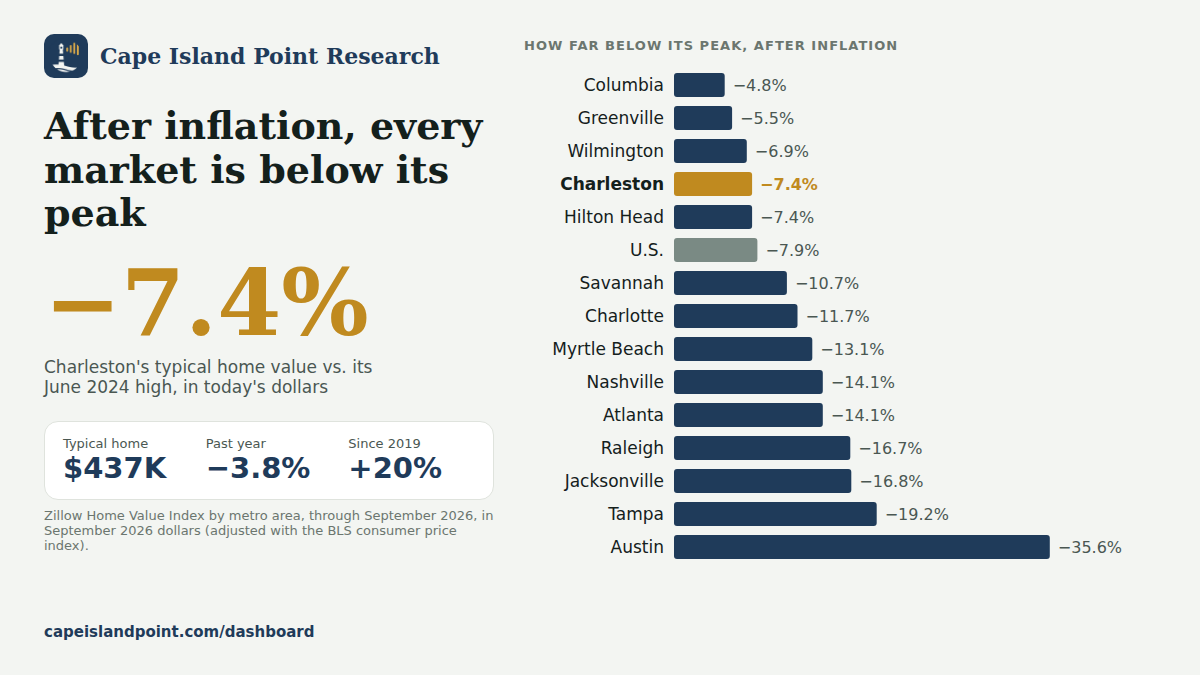
Charleston is 7.4% below its real peak of June 2024, about in line with the nation. Columbia and Greenville have held up best. The pandemic boomtowns have given back the most: Tampa is about 19% below its real peak and Austin about 36%.
Over the longer run, owners here are still well ahead. Since January 2019, the typical Charleston-area home is up about 60% in dollars and about 20% after inflation, compared with about 16% for the U.S.
Everything else on the site is in actual dollars, as reported. To see any town's home values after inflation, use the "After inflation" switch on the home value charts in Market data. Inflation is measured with the Bureau of Labor Statistics consumer price index.
Where the people are going
The Census Bureau's latest head count, for July 2025 (the 2026 figures come out next spring), shows the Charleston area still growing, but the growth has moved up the road. Berkeley County added 8,674 residents in a year (+3.3%) and Dorchester County added 3,558 (+2.0%). Charleston County added 2,943 (+0.7%).
The bigger change is where those people came from. Charleston County's net gain from elsewhere in the United States was 175 people, down from 3,298 in 2021. Most of its growth now comes from abroad (1,567) and from births outnumbering deaths (1,215). Berkeley County gained 6,830 people from elsewhere in the U.S. over the same twelve months.
One caution: a household that moves from Charleston County to Berkeley counts as a loss for one and a gain for the other, so part of this is local families moving to where homes cost less, not newcomers skipping Charleston. Either way it lines up with the price gap: $715,000 for the median single-family home in Charleston County in September, $430,000 in Berkeley. Moncks Corner is the clearest case, at 20,612 residents, up 53% since 2020.
What I'm watching
- Whether the area score drops below 40. With payments up 11% in six months, more cooling this fall and winter is the likelier path unless rates come back down.
- The 7% line on rates. A move back toward 6.5% would bring buyers back quickly, because inventory in most towns is still below what a true buyer's market needs.
- Inland days on market. Dorchester County homes took an average of 48 days to go under contract, up from 43. If that keeps stretching, expect more price cuts in Summerville, Goose Creek and North Charleston.
Have a question about the data, or a topic you'd like me to dig into? Email me. I can't advise on individual decisions, but I'm always happy to talk numbers.
— Brandon
Sources: Charleston Trident Association of REALTORS® (CTAR) Local Market Updates via ShowingTime FastStats (September 2026, single-family); Zillow Home Value Index (September 2026); Redfin Data Center (Tide Gauge inputs); Freddie Mac Primary Mortgage Market Survey®; U.S. Census Bureau Population Estimates, Vintage 2025; Bureau of Labor Statistics CPI-U. Monthly payment is principal and interest only, 20% down. See every number in Market data.